The As Yet Unknown Dungeoncrawler (Making PCs)
Upbringing, Profession, Specialties, Notoriety
After rolling for stats, roll 2d6.
One result determines the kind of upbringing you were raised to and your notoriety in the community of your birth.
The other result determines the type of profession you practiced and the number of specialties you’ve picked up along the way.. (See Upbringing and Profession Table)
I stole this almost wholecloth from Elfgame. I say stole... It's mostly a way to roll for a character in a way that is more than just an evocative name and the interpretation of the GM. System rules are meant to show how a game is meant to be played, broadly speaking, and so what it says should emphasize things that are important for the designer. Nothing should be in your game that you don't want there. There may be things you're more or less excited to have in there, but everything in your game should be something you want even if the execution is not up to your impossible standards.
Upbringing and Profession
Your upbringing and profession determine the broad application of your experience, as well as any additional advantages allowed to you at the beginning of the game. Your profession determines your character's level of skill, which modifies your Luck and Experience TNs
I may change this eventually, but the idea behind this table is to emphasize something that is more or less an unspoken assumption in these types of games: You had a life before this and you can't leave it all behind, but you don't have to be defined by who you were forever. All characters were something else before they became crawlers (is Maggot the derogatory term for people who crawl in ruins ? takes notes vigorously) and, for some at least, the goal is to become more than that. I don't know if I want anything like Draw Steel's Inciting Incident mechanics, which deal with this topic by by forcing the player to think about their character for more than three seconds. This seems counter to the spirit of this kind of game, which ideally should make character creation as quickly as possible to replace any untimely deaths. Whether or not this is that kind of game remains to be seen.

This game is set in the area and period of my game (The Reign of the Sorcerer Princes) where there is a stark divide between the social classes, with the Mages and Miracle Workers at the top of the social ladder. I wanted to highlight both the diversity in Experience required to occupy certain professions and the relative equality of all comers to the dungeon. Everyone is equally likely to succeed or perish when they first start out. In my mind that's the appeal of the Dungeon in a nutshell. It's a chance to change your stars.
 " />
" />
Shut up. You're crying too
Specialties
Specialties allow you to attempt more tricky maneuvers than general experience might. If the GM determines that your specialty applies to a test, apply +1 to the TN. Similarly, if your specialty would apply to a situation in a way that either guarantees success or reduces risk to a trivial degree, the GM can choose to have you succeed without a roll. Inversely, certain things can only be known if someone has specialzed in the topic. When you create a character, pick one of the General Specialties. some Professions allow you to take another one.
In general I don't like skill lists that promise a lot but deliver next to nothing. Learning a new Skill should also be one of the ways in which a character can improve their Experience, which is why the bonus is just +1. Specialties are also triggers for spending Experience to automatically succeed, if only suggestively. If you give a player a list of skills, you can't be surprised that they're going to use it to solve problems. That's ok. The death spiral built into the game will make sure that players will soon run out of Experience to spend.
General Specialties
These are specialties that are most often useful in a variety of situations, both in the Overworld and the Underworld.
Climbing
Hunt (identify and track living creatures across terrain)
Languages (can be taken multiple times)
Decipher (Codes, Mechanisms, complex calculations, etc.)
Flirt
Sway
Explain
Letters (Reading and Writing in all languages you may have)
Handle Animal
Ride
This is basic, and that's ok. This is basic, and that's ok.
Underworld Specialties
These are the specialties that come up most often while navigating a dungeon in the underworld, and would be considered strange, sometimes even illegal, if employed in the overworld.
Brawl (Up close and personal fighting)
Skirmish (Ranged and mobile fighting)
Pick Locks
Conceal Objects
Tie or Untie knots
Move unnoticed
Hide
The Underworld/Overworld division is to highlight the two main phases of gameplay: exploring the dungeon to get the things you need to accomplish your goals in the Overworld, including getting better at exploring the Underworld.
Overworld Specialties
These are specialties that come up most often while enjoying the fruits of your expeditions in the overworld, where you have to interact differently.
Barter
Enchant (identify and process relic crafting recipes)
Brew (identify and process herbal recipes)
Distill (Identify and process Alchemical recipes)
Masonry (Build structures that last, carve stone)
Carpentry (Build wooden structures, carve wood)
Smithing
Bowyery
Ropemaking
Tailoring
Leatherworking
Study (learn about a specific subject with the help of a tome or teacher)
Communitiy and Notoriety
Your notoriety measures how big of a deal you are in your local community. Whether positive or negative, you are known to your community, which impacts how people perceive and treat you. A low notoriety usually means you blend in a crowd, and generally go unnoticed in social settings. A high notoriety usually means people recognize you in some way, which labels you as someone to either seek out or avoid.
When you begin playing, the GM should have laid out at least 1 community that knows you.
Notoriety is one of those things that I look for whenever people talk about "Social mechanics". Your character is not a complete unknown to everyone, they have some kind of reputation, and managing that reputation in the Overworld may be something that they might want to keep an eye on. It's also important to me that a high notoriety is not necessarily a good thing.

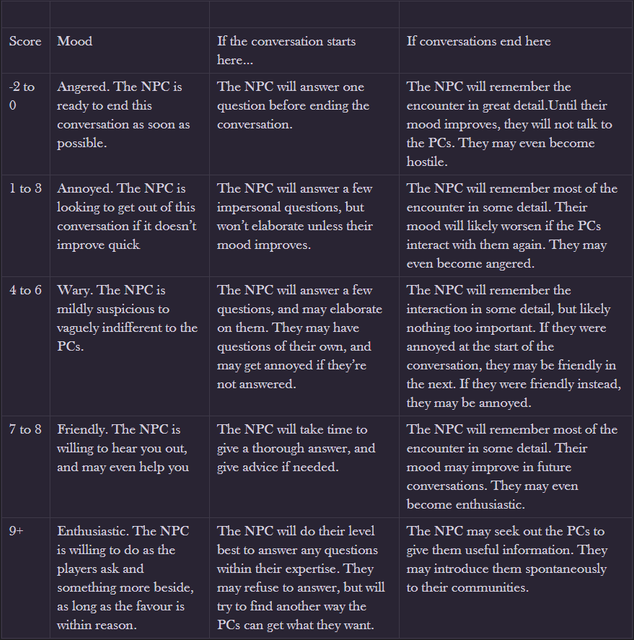
Mood Rolls
When the player characters meet someone, whether in the Underworld or the Overworld, that they wish to engage with socially― as in no one here is willing to fight― the GM determines the NPCs’ starting mood based on the situation or by rolling a d10, adding any modifiers from the PCs’ notoriety. If the NPC does not come from a community to whom the PCs belong, their modifier is 0. If the NPC is hostile to the PCs, they may not wish to speak with them, and may fight, flee, or freeze as the situation escalates.
This is essentially Reaction rolls with extra steps, but I don't think you need more than that when running the game.