Crunch Crunch: Tactical Grid Games
The Straight Dope
This post comes to you because I was at a convention running Draw Steel and found myself in an alll to familiar position. The players immediately ditched the set encounters to chase a villain who had escaped. Upon catching the villain, they found themselves at the bottom of a marsh surrounded by undead. There was no set battlemap or encounter for the situation, but it was clear that they would need to fight their way out in order to get out of this sticky situation. A combat encounter needed to be drawn up, and I had less than 10 minutes to do it.
While grid-based tactical ttrpgs often rely on set-piece encounter design, it is by no means impossible or even difficult to improvise a tactically interesting combat in a crunchy system. It simply requires some skill. If you want to get better at designing combat encounters on the fly you need to think about the following:
- Forget about Balance, set the encounter to the situation.
- Make the Stakes Clear and the Objective Simple
- Draw a Battlemap in terms of squares
- Keep the Encounter unfinished.
Set, Game, Crunch
I think crunchy tactical games get a bad rep when it comes to improvisation. Not without good reason, I might say, if I were Justin Alexander 1. Games such as Pathfinder, 4e D&D, Lancer and Draw Steel tend to require a lot of effort and planning to run an interesting combat, which in turn gives the impression that the hard work should not be wasted just because the players decided to zig when the encounter required them to zag. This leads to what I call "set piece" design. It usually takes the form of a perfectly arranged battlemap that poses the perfect combat for a specific set of player characters. Some people refer to this kind of design as "My precious encounter ™" 2 and to them it is explicitly a "bad thing"... and they may have a point.
Don't get me wrong, there's a place and time for set piece encounters (notably a lot of boss room encounters or pitched battles are set piece), but they are at best a sometimes food3. And if you want to play a game where the situation changes constantly based on the choices made by the players and their characters they are a rare treat, like absinthe or profiteroles. Hew too close to them and you risk locking your game onto some tracks that you didn't know you laid (blimey). Set piece encounters shine when they are half-finished rube goldberg devices, they kick of an ever-changing situation of violence that not even you, the encounter designer, can accurately predict.
That being said, they are often little self-contained stations that the player characters can interact with on the way to the climax (blimey), which means that if there is any kind of hiccup or kink in the works the whole machine either grinds to a halt or grinds down the players' agency. This― I am told― is bad...
But my degree in philosophy prevents me from thinking that just because there are bad actions of a kind means hat all actions of that kind are bad. Just because some set-piece design leads to bad gameplay does not mean all such design leads to bad gameplay, but I digress... On to the tactics!
Snap, Crackle and Crunch: Part of an Unbalanced Breakfast
Tactics is not something which depends on a game system. Or at least it's what this blog tells me4. Despite the fact that the author repeats the much overblown OODA loop and thus participates in the myth that is John Boyd 5, it does have a good point about tactical thinking: it doesn't care how you roll the dice. But what does that mean for crunchy games?
Basically it means you need to let go of the idea of a "balanced" encounter. Or rather you need to reconsider balance as something you calibrate for a specific purpose rather than an ideal state that is universally good. Encounter design is balanced for a specific experience, but the rub of all design is that you need to experiment to learn how to balance, and this is where improvising encounters comes in.
To know what makes a good improvised tactical encounter requires that balance be calibrated to the situation in the game, not some ideal metagame of character resources. Often this kind of balance has a negative aim: the point is not to needlessly kill a PC or worse, kill all PCs. This is, ironically, an easy goal to set, because as anyone who's played the internationally reknowned card game Wizard knows it's easier to avoid taking tricks than making them.
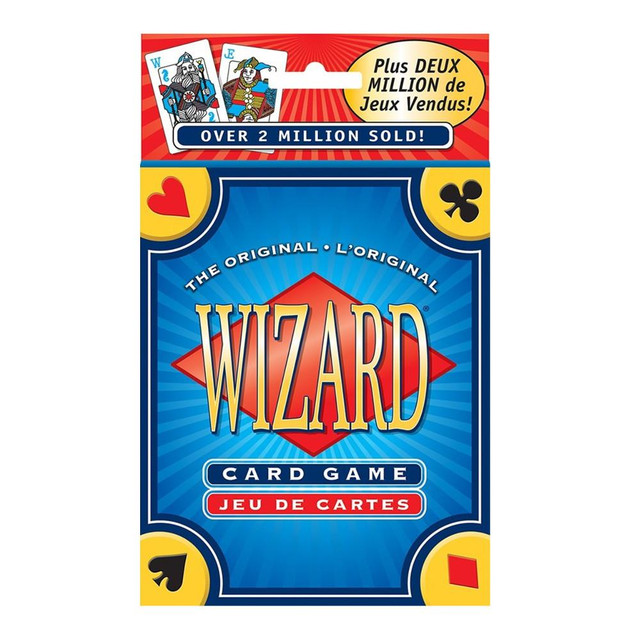
Shout out to all my Wizard Fans out there.
While I still believe in balancing design in the sense of calibrating rules for a given set of experiences6, I must concede that the place for that kind of calibration is not during the session. Let us then conclude that for the purposes of improvising a tactical combat balance is not a concern outside of absurd scenarios that end as soon as one side or another takes a turn.
So what is left once Balance leaves the scene? The situation. The very reason you're improvising a combat is because your players landed themselves in a sticky situation that calls for violence. once the encounter starts, the situation keeps changing until violence is no longer the chosen course of action. Instead of centering your design on the abstract possibility of PC death, think of the situation that led to combat.
To bring back the example of my Con game, the players were split across a map, with an unconscious NPC they needed to drag up a hill, and skeletons rising from the muck trying to bring them down. This is already not an ideal position to start an encounter, but to make matters worse I had 1 player character start at the bottom of the marsh and the rest start at the edge of the map to better represent the situation I had described, and then surrounded that PC with skeletons. By any measure of difficulty, this is easily an unbalanced situation. It also provided stakes to the ensuing combat. (The PC survived btw)
Crunch Time: Creating Clear Stakes and Simple Objectives
Having done away with Balance, we can focus on establishing Clear Stakes and Simple Objectives for our encounters. This is good advice to follow in encounter building period, but it is especially crucial when you have only a few minutes to create a combat. The first thing you need to determine is Stakes. What happens when the PCs win? What happens if they lose? If the answers to any of these questions is "Not much", then you probably don't need a combat7.
A good combat requires clear stakes at its heart8, otherwise you're just relying on the players' good will and momentum to carry the day and sets you up for a slog should that good will flag. Again this comes from reading the situation. To use my previous example: The party found themselves at the bottom of a marsh surrounded by undead with an unconscious NPC they want alive. In this case the stakes are fairly self-evident. If they succeed, they make it out of danger with the NPC. If they fail, they lose the NPC.
As stated previously, one of the more common kind of stakes is PC survival. Will the heroes succeed by surviving or die trying? It is both quite easy to set a combat with this kind of stakes and quite hard to execute it well. It also leads us back to thinking about balance, which we want to avoid at this stage. Other common stakes include:
- Someone has a Macguffin. Someone else wants it. Whoever wins gets the Macguffin
- Someone is trying to make something happen. Bad things will follow if they succeed.
Broadly speaking, you need an answer to the question: What happens if the heroes lose? This also presupposes that they can lose the encounter, but we'll get to that later.
Once the stakes have been drawn, it might be useful to set an objective, which places your narrative stakes in a mechanical situation that signals the end of the encounter. Draw Steel has a nifty list of combat objectives in their Monster Rules9, but I've boiled it down to a few basic archetypes:
- The Gauntlet: The heroes must cross the map while enemies try to stop them.
- Stop/Start the Ritual
- Escort/Save the NPC
- The Stand: The heroes must prevent enemies from crossing the map.
- King of the Hill
- Red Rover
- The Fight: Heroes must defeat one or several enemies or destroy an object.
- Defeat X Enemies
- Cut the Head of the Snake There are countless variations on these types, each applicable depending on the situation. What is most important is choosing a simple objective must accomplish to succeed in the encounter, or more pointedly, to avoid failure.
If you establish clear stakes and simple objectives, the combat is half done. What is left is drawing the map and choosing the monsters. In the case of my Con game, the stakes were clear enough: If you stay here you will be swarmed with undead and die. The objective was then so simple as to go practically unnoticed: Get the NPC off the map to escape the undead. Easier said then done when you have to cross the map to do it.
Grid-locked: The Grounds of Battle
Any combat relies on presenting clear obstacles and opportunities for action to the players. A grid-based combat cares about putting those obstacles and opportunities on a map, where players can consider it independently of the GM's descriptions10. On the grid, adjudication for the situation is in the hands of all players who are able to read the battlemap. Thus a good battlemap drives the quality of a good encounter.
The only problem is we don't have enough time to meticulously draw the perfect battlemap. We have 10 minutes to put something together while the players are taking a bio-break. So here are the quick and dirty tips for drawing a tactically interesting map:
- Don't use maps bigger than 25x25. A map that is too large leads to slog.
- Draw Obstacles and Opportunities based on the situation. A swamp has trees and mud and deep places that are hidden. These can be obstacles to the PCs, but also opportunities for them to exploit to their advantage.
- Think in terms of squares. Regardless of whether your system uses ft. or not, count your obstacles and opportunities in terms of squares. Each sufficiently large object is treated as if it occupies 1 square or more.
- Block lines of sight. There should be no straight, unobstructed lines of more than 10 squares without good reason.
The Battlemap for my con game looked something like this:

The Square was a large rock sticking out of the ground, the center of the map was flanked by 2 steep slopes, and the circles were trees that blocked line of sight. At the bottom is the NPC with the lone Fury standing by them. On the left edge of the map stands the rest of the party, that must now decided whether or not they're going down in the muck to help the Fury or picking off the many enemies from above. These simple shapes aren't the best kind of map design, but not bad for 10 min work.
Leave Things Unfinish...
The last thing you need to do is keep the encounter open-ended. In other words give your monsters a way out and possible reinforcements. Improvisation of any kind requires a certain level of flexibility that can only be afforded by the tools you give yourself in a performance. This means that when you improvise an encounter you need to give yourself a way to adjust the encounter on the fly, all while remaining in the truth of the secondary world. No quantum Ogres here.
First you need to give your monsters a way out in case they decide mid battle to leave. As much as the players have a stake in the fight, so do their enemies. When the going gets too tough for them, they can try to leave, which may lead to another encounter, but that also changes the conditions of the test. If the heroes choose to pursue, it will be into the unknown.
Second, you need to ask if your monsters would reasonably have reinforcements, and how they could call them. This is a great way to ratchet up the tension in a fight that seems to be a bit too easy for the players. It can also be another kind of stakes for the encounter: stop the guards from calling for reinforcements.
Leaving the encounter unfinished is perhaps the most important bit of advice in here, because it is a reminder that no matter the system, anything improvised will be, by definition, unfinished, because improv requires a scene partner. The players and their characters are the scene partner to any combat, but especially an improvised one.
For a final example from my con game, I had the marsh spawn more and more skeletons at the end of every round of combat to signal to the players that killing all monsters was not a way to solve the problem, and acting like a murder hobo would make things worse.
A Side Note about Monsters
Improvising a combat has little to do with system and everything to do with how a combat is imagined. The main thing to take into account is the stakes, the objective, and the map. Monsters will be system dependent, of course, but they don't have to be perfect and any monsters you may have already prepared for one of your set-piece encounters can be perfectly usable. Choosing monsters is important, and definitely a necessary step to up your prepped encounters, but the improvised encounter is the laboratory of design. Just read the situation, place as many monsters as appropriate, and see where it goes from there.
Thank Fuck for that↩
Editor note: Make sure not to overindulge when you have set piece encounters, that can lead to an upset stomach.↩
To those people who don't know Lazerpig: I don't apologize and you're welcome↩
Editor note: Skill issue.↩
Editor note: What about the love of inflicting violence on others and having violence inflicted upon you? Is that not enough? Author note: Sometimes love is not enough. Editor note: You would say that.↩
Editor note: Just like most vampires should get.↩
MCDM, Draw Steel: Monsters, p. 15-24↩
Kyle Latino of Mapcrow fame drew this neat little list of encounter templates↩