Crossing the Rubicon
Crossing the Rubicon
It goes without saying not everyone is going to agree with what I have to say here. When I showed the outline of this script to my editor, the first thing she told me was: “I’m going to kill you for this.” Given her extremely busy schedule I chose to take that as a compliment. Nevertheless, I persisted. Because while I don’t care whether people agree with me or even like what I have to say, I care that I’m going against received wisdom and so I better come prepared. I believe I have sussed out a small point in the Discourse(™) that has been bugging me for years and I hope my argument makes sense. So here goes:
The Straight Dope
Stop calling adventures “linear” or “non-linear”. It’s cringe and bad. The linear/nonlinear dichotomy is a bad way to think about games, because it fundamentally misunderstands the meaning of those terms. It gestures to a real point of contention: agency and determinism, but it fails to describe it in a way that I find useful.
Drawing the Line: How there is no such thing as a non-linear adventure
“Linear” is said in many ways, to paraphrase the Philosopher 1. I’ve chosen the three most pertinent uses of the term as they can apply to ttrpgs:
Geometric use: “Linear” as a spatial term
Narrative use: “Linear” as a temporal term
Agentic use: “Linear” as a causal term
I have chosen these three uses of the term to highlight three different ways in which ttrpg modules can be seen: as a space, as a narrative, or as a set of limits to player and character agency. I will show how in the first two uses, Linear and non-linear have no real application as terms used to describe ttrpgs save perhaps pedantic ones 2. As for the third use, I would argue that the linear/non-linear dichotomy could apply, but needlessly flattens a nuanced and multi-faceted field of discussion to present a neat binary.
Both the Geometric and Narrative use of “linear/non-linear” effectively point to the Agentic use as a foundation for their own arguments. “Linear” dungeons are bad, whether it be through the space or the narrative of the module, because they unduly restrict agency. Thus the meat of the discussion is to be found in the third use of the term, but we will go over the first two to better highlight the actual use cases
Linear as a spatial term
One way in which “linear” and “non-linear” is used to describe ttrpg and ttrpg modules is in the case of a space, more often a dungeon. In this usage, a “linear” dungeon is a space in which the rooms are laid out in a sequential order that more or less dictates the flow of play. The shape of the basic 5-room dungeon (which isn’t a dungeon) is a prime example of this.

Hmmm. I can hear “It’s A Small World” already.
This is the line, the Ur-example of a line, dare I say it… the platonic Ideal of a line3. It’s also one of the worst pieces of design for ttrpgs I’ve ever seen. The 5-room dungeon was meant to be a quick and dirty fix to a specific problem, namely a GM who’s either burned out or unprepared or both trying to find content for game night. That it be used as a cornerstone of module design is flabbergasting.
The flaws of the 5-room dungeon are many, but suffice to say that in this basic shape we can say that it is the ideal prototype to a linear dungeon or linear adventure : A leads to B, which leads to C, D,E, etc.
The use of “linear” as a term to describe space is clear, but it is also narrow. If we can allow for the sake of argument that linear = bad then all we need to avoid a linear/bad dungeon or adventure is to avoid linear spaces. This means that jaquaysing the dungeon truly is the silver bullet to our adventure design woes. Pack it in ladies, turns out the solution was looping rooms and multiple entrances all along.
Obviously this is not what most people have in mind when they say that linear dungeons are bad. The issue is less with the actual shape of a dungeon and more to do with the effects on play. A spatially linear dungeon certainly is not an exciting dungeon, but why it’s a bad dungeon is not just because of its shape. Rather its shape is only a symptom of a greater problem. As an example of what I mean, let’s take the 5-room dungeon again. While the shape shown earlier is comically linear, the 5-room dungeon is just a series of 5 nodes, which can be arranged in different configurations, 21 of them to be exact.

The horror
If we are to take the argument “a linear dungeon is a bad dungeon” seriously, we need to expand our definition of “linear” to see exactly what is wrong with it. Which brings us to our second definition.
Linear as a temporal metaphor
The second use of “linear” to describe a game is to compare adventures to narrative structures and nod sagely when someone points out that a novel is not, in fact, something a ttrpg can or should do. It goes around the argument that most dungeons are not strictly speaking a line so they can’t be linear. While this is an extremely disingenuous argument, it has thankfully been debunked time and time again. As shown above just because you jaquaysed a 5-room dungeon doesn’t make it non-linear, or good, or even a real dungeon.
In this second use, the linear dungeon is a narrative or temporal metaphor. The line is not the actual shape of the dungeon but the sequence of rooms or events that have to happen in order to complete it. A leads to B leads to C, etc. The 5-room dungeon is a linear dungeon in this sense, because no matter what the spatial configuration of the damn thing, you will always have those same 5 rooms in a sequence. The actual order sequence does not matter. Only the fact that we can abstract the structure of the adventure and place it in a line 4.
Temporal linearity is also the most common kind of linearity you will see, especially if you’re talking about ttrpgs as “collaborative storytelling”5. It assumes that the adventure takes place not only in a given space, but a set time, a time in which other things are happening that will not happen again. In traditional spaces this is known as “event-based” adventures, distinct from “site-based” adventures which are more like your typical dungeon module.
An event-based adventure not only has shape, it has directionality. Once the ball starts rolling it has to keep going until it reaches its logical (see narrative) conclusion. A lot of traditional WotC adventures are linear in this specific way even though some of them, like Curse of Strahd, are very loose in that linear structure, which may lead people to believe they are non-linear. One reason these adventures follow a linear path is because the design team wants to make sure challenge follows the PCs as they level up (Both of the WotC examples are for level 1-10). It also gives a nice sense of progression both narratively and mechanically. Strahd feels like this invulnerable threat at level 3 but by level 10 you’re ready to clown on the guy (especially if your GM doesn’t know how to run the statblock).
The issue with event-based adventures, or “plotted adventures” if you follow a certain internet curmudgeon is that the narrative structure that pushes things along is effectively a railroad6. This is an extreme view on the matter, but it makes a good point about the differences between the structure of ttrpgs vs the structure of stories7. A story tries present a coherent set of events and characters according to a plot, which ties these elements together in a discursive (and linear) series of causes and effects. Linearity affects stories in two ways: first the linearity of the story itself (the plot has a beginning, middle, and end that flows from one to the next); second the linearity of the story as it is read (the story as the reader understands it).
The linear plot is the most common found in fiction, and is also the subject of much experimentation. A lot of “non-linear” storytelling is a result of cutting up and rearranging the tropes associated with the way in which causality and linearity works within a plot. Thus we can stretch the limits of how we conceive of time in ways that aren’t strictly linear: flashbacks, simultaneous storylines, time stops, etc. Christopher Nolan’s experiments with time and storytelling in Memento and Tenet and Intersterllar are good pop culture references to what can be achieved by messing with the chronology of narrative.
This experimentation, however, is mostly simulation. In truth linearity is restored in the mind of the reader/viewer, both as a lived experience― we all read the book or watch the movie one page/scene at a time― and as a reconstructed narrative― when we try to make sense of what we read or watched, we package it back into a linear causal chain (X happened because of Y). This return to linearity is important with regards to ttrpgs, which are in practice fundamentally rooted in speech, which is discursive and therefore linear, and shared understanding, which relies on making sense of what is happening. The game is more than the module and has to make sense to everyone, which implies a kind of linearity in how the game information is presented. We all go through the dungeon one room at a time, and we remember the adventure as a series of events and characters that follow form one to the next. In this sense all adventures, as conceived as experiences, are linear.
But this isn’t what people mean either when they say linear adventures are bad. Narrative structure is something that is imposed after the fact of play. Stories are what we tell when we stop playing. During play we experience a kind of mundane linearity because we experience the dungeon one room at a time, and when we revisit the dungeon that room will not be the same. But the kind of linearity that is typical of the 5-room dungeon and others of its ilk has little to do with the linearity of time, but rather the inherent linearity of what makes ttrpgs special: Action and Consequence.
Linear as a causal metaphor
Earlier I said that narrative linearity is a sequence of events and characters appearing in a set order. The causal links between those events and characters are bound up in the plot of that narrative. Indiana Jones the character can do nothing else but give up the grail to save his father, Anakin Skywalker can do nothing else but become Darth Vader, Rand al’Thor is doomed to be my personal nemesis in fiction face the Dark One at the Last Battle. While narrative has causal linearity, I hold it distinct from the temporal use of “linear” because time doesn’t care about causality except in the sense of irreversibility. What has happened cannot be made as if it never happened8, but the passage of days cares naught for the works of man.
Causal linearity is found in ttrpgs through the main conceit of all such games: player decision and character action. A lot of hay is made in the received wisdom that a meaningful game is one in which the characters actions (or the players’ decisions) have meaningful consequences. This is a part of the broad consensus with which I have little issue, save for the fact that it is often used by morons trying to argue that character death is the only meaningful consequence you can have in a ttrpg. This is also where the issue of “linear adventures” finally finds its teeth.
In a traditional “linear” adventure, like Storm King’s Thunder, the structure of events is as follows:
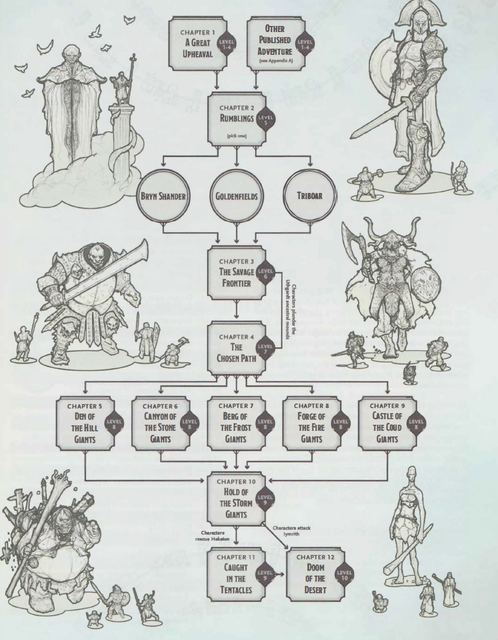
All of the chapters of the book are meant to be content that is experienced one at a time, following a set path that leads the characters from one scene to the next. The causal chain has already been decided for the players. No matter what they do, their characters will be shown to the next stop on the Copyrighted Disney Faux Multicultural Puppet Ride and the adventure will continue. The only decision the players need to make is which flavour of nightmare fuel they want to experience. It is a fundamentally consumerist choice, a choice between equally viable options, with little consequence other than perhaps the satisfaction or disappointment of our specific taste.
The linearity does not just occur on the scale of the adventure’s structure, but also within individual chapters.

As we can see, the very text of the adventure affirms that the characters will accomplish the necessary actions in order for the story to continue. They will :
Secure the village of Nightstone
Locate the missing villagers
Accept the quest to the next chapter from the friendly NPC
Accept the NPC’s offer of a ride in his flying tower
Fend off an attack against said tower
These are all things that the heroes must do in order to advance. Otherwise there’s no path forward. In other words, these are all ways in which the causal chain can be derailed, a series of failure states. And that’s just chapter 1.
There is another form of linear design which is more problematic than this, and it’s best exemplified by Wild beyond the Witchlight. In the first chapter the characters are sent to a magical carnival to find a portal into the Feywild. During their visit they can participate in carnival games and either bring the mood up or down while they look for a way into the Feywild, which must be accomplished by meeting the Carnival's owners: Mister Witch and Mister Light0. The entire chapter is a series of minigames and npc interactions that can make the mood of the carnival go up or down. The problem starts to show itself in this paragraph:
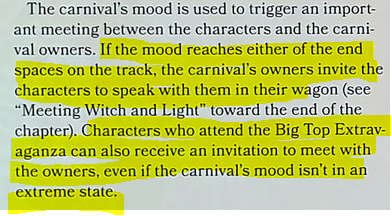
There is no difference whether or not the players fully engage in the spirit of the carnival; they are invited to speak with the owners regardless of their decisions. This is because the design of the adventure has created a bottleneck and has then left the designers with no other recourse than to give as many chances for the players to hit the necessary steps to advance so that they can continue on the adventure. The other options are being kicked out of the carnival or otherwise losing the opportunity to get into the Feywild. This is worse than just linearity. This is railroading. The only difference the players can make to the adventure is by outright refusing to go along, which is not exactly what I would call good game design.
To a certain extent an adventure module requires some buy-in. There can’t be an adventure if the players don’t want to play along, but there is a point where the adventure itself needs to give players an incentive to engage with it and “do you want to continue?” is not a compelling enough reason on its own. You go along with the ride when you read a book or watch a movie or go to a theme park. You play ttrpgs so that your decisions, and your character’s actions, change the way the world is, no matter the scale.
And so the actual issue with “linear” adventures is a causal chain that either assumes ultra specific behavior from the players (as is the case in Storm King’s Thunder) or enforces that behavior through railroading (as is the case in The Wild Beyond the Witchlight). In the first case the assumption of a certain narrow set of behaviors leaves open multiple points of failure where the adventure can go off the rails, which requires more work from the GM to make work. In the second case the players’ decisions do not actually impact the world other than through the prescribed channels of the adventure and whatever choices they may have are the same as choosing which flavour of ice cream you’ll have even if you wanted waffles instead.
If we go back to the 5-room dungeon, we can see this clearly. No matter how many 5-room dungeons you go through, it will be the exact same 5 rooms no matter what, and the only choice the players need to make is the same as with any adventure of this kind: Do you want to continue? I don’t know about you, but that kind of stuff is not what I signed up for when I started playing ttrpgs.
Lines in the Sand
Now we’ve identified the actual crux of the matter― the excessive limitation of player decision and character action on the state of the world― there is matter to discuss regarding the continued use of the linear/non-linear dichotomy. I propose that it is a dumb metaphor that obfuscates the issue at hand.
The shape of a dungeon is incidental to its supposed “linearity” and, as discussed previously, the passing of time in a line is built into the ways in which we talk about the game we play. The only strong argument in favour of the dichotomy is the causal chain argument. Causality happens in a line, and if that line is already drawn with no recourse to deviation or redirection, then an adventure is “linear”.
While this is true, it invites the use of the other two metaphors, if only because historically those were the examples people have used since there’s been debate on this issue. If we got rid of the line metaphor and instead focused on what constitutes an acceptable set of limits on player decision and character action, then we can have a much more fruitful conversation than “line = bad”.
Another reason to ditch the dichotomy is that there is clearly an interest for dynamic, event-based adventures out there. By reframing adventure design to be about creating interesting player choices and contextualizing those choices in a temporally dynamic way we can rehabilitate the event-based adventure so that it is not inevitably a railroad. This will mean shifting our expectations away from site-based design and truly think of the adventure as moving forward in time. One key example I have in mind for this is this timeline from 3e’s Red Hand of Doom.
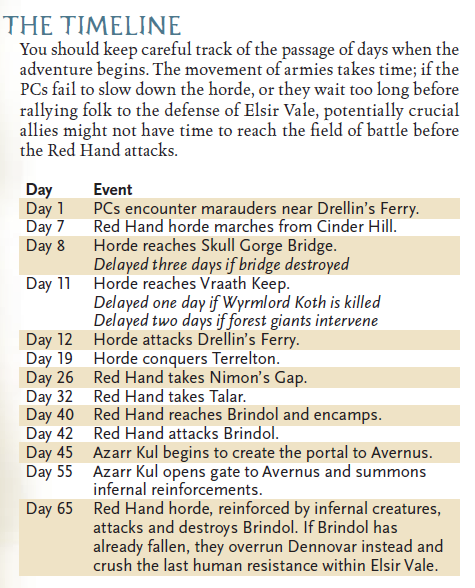
Notice how, unlike in Storm King’s Thunder, the language here is mostly about what will happen unless the heroes do something. The Horde reaches Vraath keep on Day 11 unless Skull Gorge Bridge is destroyed, in which case the defenders of Elsir Vale have another 3 days to prepare. By all measures Red Hand of Doom is a linear adventure. It starts with the heroes learning about a hobgoblin invasion of Elsir Vale and ends either with the heroes defeating Azarr Kul or letting the warlord destroy every human settlement in sight. I would not call this a railroad even if it has events which force the players’ hands. It makes for an initially reactive adventure, at least in the beginning, but the timeline is not a prophecy doomed to be fulfilled. It’s a promise to the players that unless they take steps to stop this, the events described will come to pass.
The problem isn’t that events in an adventure happen in a line. The problem is that determining the agency of players and characters becomes much more complicated when you have to think about things in motion rather than statically. Laying out a villain’s plans requires more thought about what the weak points of said plans are than describing how many goblins are in the next room or the percentage chance of the dragon being caught in their lair. It may not be worth the effort from a designer to think of adventures or dungeons in this way, but I believe that modules are not just content for a given game, they are also crystallizations of game practices and gaming cultures, so if there is a way to make event-based adventures better, I would think the extra work be worth it.
I would go over the actionable steps we could take to think about adventure design outside of the linear/linear dichotomy but I feel that should be reserved for another post. In that other post (which I will definitely write… I promise) I’ll go over the reasons why I think situations are a coward’s solution to the problem of player decision and character action as well as the best ways to use murphy’s law to screw over your players. But until then you’ll have to be content with these 3500-odd words of theory.
That’s Aristotle. Metaphysics, Book IV, Part 2↩
The irony is not lost on me I assure you.↩
Take that Euclid!↩
I guess you could start the dungeon with the Twist/Treasure room, but frankly I don’t want to know what you get up to if that’s your idea of a fun time.↩
Another concept I have a bone to pick with, but that’s another post.↩
Or at the very least the ticket line to a railroad.↩
This is also part of the argument against framing ttrpgs as storytelling, but I digress.↩
Retcons are just a form of amnesty. An agreed upon amnesia of what happened in order to move forward.↩